Recap
REC.Keeping Up With AI While Working Full Time
April 18, 2026 @ 2:00 pm - 5:00 pm
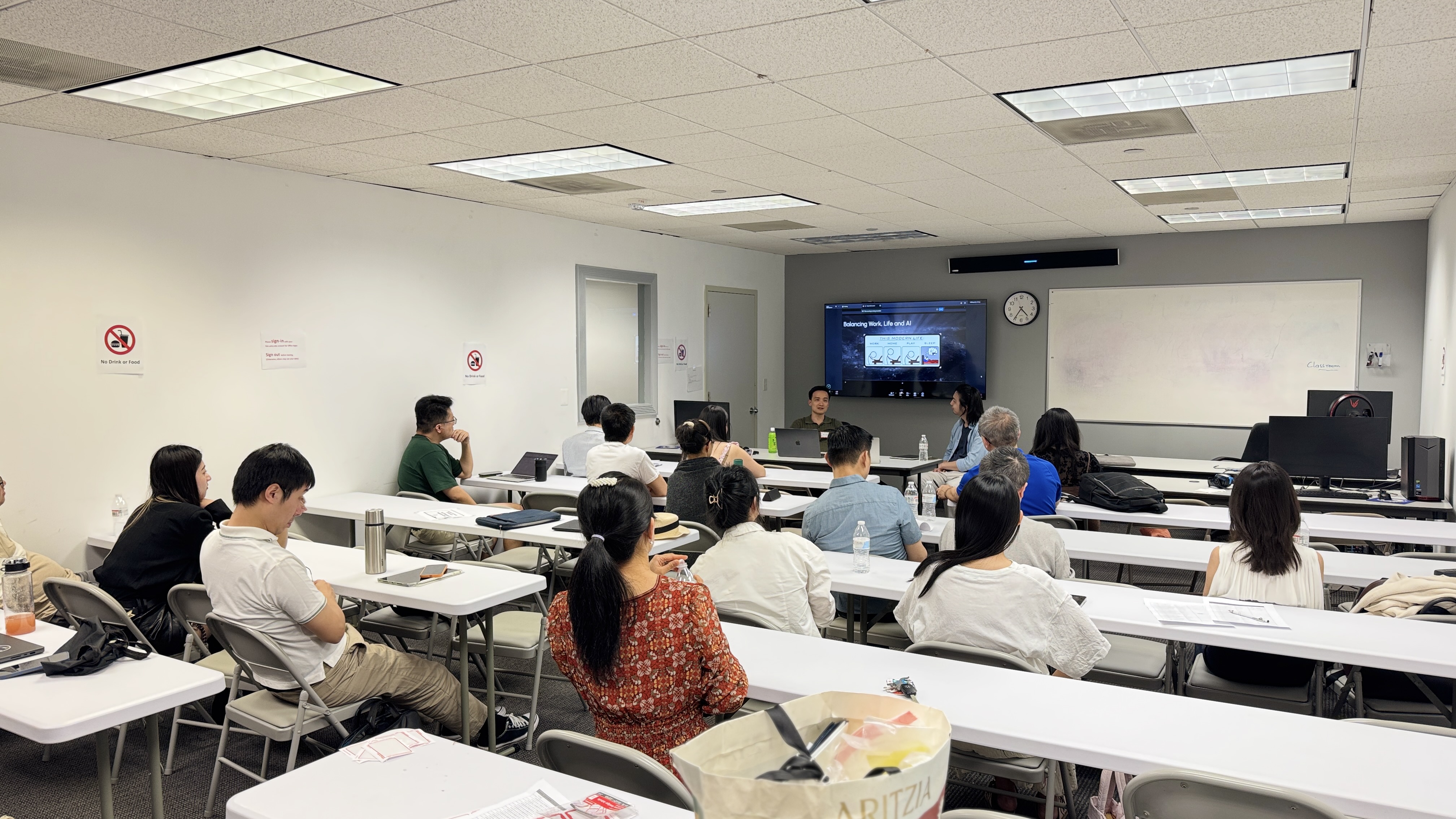
CADSEA hosted a two-hour session with Carson Yan — Senior Director of Data Science and Product at Capital One, indie developer by night, and founder of Teaky AI and Motion Control King. His own three-word bio: Builder, Data Scientist, Father. The session was built as a conversation rather than a lecture. As Carson put it in the opening minutes: "I'm not here to do one-way communication. I'm here to explore this together." Questions ran almost continuously for the full two hours.
Starting With the Anxiety Carson opened with a slide titled "Let's Have Inner Peace Amidst The Great AI Anxiety Spiral" — and a quote from his ten-year-old son: "AI evolves too fast and I don't like that." His answer to that anxiety isn't consuming more information. It's Building to Learn: pick a project deliberately unrelated to your day job, and build it. Not to start a company — to stay fluent.
Vibe Coding vs. Agentic Engineering The centerpiece of the talk was a distinction Carson thinks most people get wrong. Vibe coding: "Hi Claude, please build me an app to track my personal finance." Open-ended, unspecified, and in his words "completely outsourcing your own thinking process."Agentic engineering: "Work on the next phase of features, use the Supabase MCP for database migration."Six days, three of them spent talking Carson shared a case from a CADSEA alum who built a voice-enabled customer servicing agent in six days — comparable to what an engineering team would produce in three months. The allocation matters more than the total: the first three days involved no code at all. They were spent clarifying what the product needed to be. Implementation began on day four. Carson's own workflow mirrors this — 18 planning documents before writing code, covering database design, design principles, and a full feature breakdown down to how each would be validated and tested. A metric you can hold yourself toThe longer you can make the AI work without checking with you, the better. When an agent keeps returning with clarifying questions, that isn't a model limitation — it's an underspecified brief. And if your idea is still fuzzy, hand the problem back: ask "Can you interview me for my ideas?"
Two Practices Worth CopyingUse skills to escape the generic look. The reason AI-generated frontends look the same — the blue palette, the emoji — is that no skill was applied. Install a frontend engineering skill, declare in CLAUDE.md that it must be invoked, and the output changes character entirely. If you run Claude Code, Cursor, and Antigravity, symlink one skills/ directory into all three rather than maintaining parallel libraries. Add one line to your system prompt. From Carson's own configuration: "When you're unsure, search online for latest knowledge." Every model has a training cutoff, and models state outdated information with complete confidence. This instruction sends them to verify.
The One-Person Firm Phenomenon Carson presented Medvi as the case that makes the trend concrete. Founder Matthew Gallagher launched the telehealth company from his house in Los Angeles with $20,000, no investors, and no team. It reported $401M in revenue in its first full year and is tracking $1.8B this year. The company is Gallagher and his brother. For scale: HIMS & HERS produced comparable revenue with 2,400 employees, at roughly a third of the margin. He kept brand, paid media, checkout, AI-run customer service, and customer data in-house — and outsourced licensed physicians, prescription processing, pharmacy fulfillment, shipping, and compliance. "This might be an outlier. But these examples are going to keep multiplying."
If You're Serious About Solopreneurship
- Don't build anything before you validate the pain point.
- Don't validate with friends and family. They will tell you it's great.
- Find your community on Reddit and X, and pay attention to what people complain about.
- Build the MVP fast. A one-person company cannot go broad.
- Record and document your build process.
On validation, one pattern worth copying: build a landing page and waitlist offering a 50% launch discount, and only start building once signups prove demand. On documentation, he was emphatic — this is the most common regret he hears from solo founders, himself included: "The thing most founders regret is not recording the process."
Live Demo: An Idea Through YC Office Hours The session's most memorable stretch was unplanned. Carson introduced gstack/superpower — YC President and CEO Garry Tan's Claude Code configuration, open-sourced as 15 opinionated tools acting as CEO, Designer, Eng Manager, and QA. The repository has 34.5k stars. He ran the /office-hours skill and invited an attendee to test it live with a real idea from her own work: an AI service helping Medicaid and Medicare providers write stronger service authorization cases, so patients receive the care hours they medically qualify for. The model did not flatter the idea. It identified prior authorization as a genuine and costly problem while noting this is not a novel space; reframed her description into a single sharp positioning statement; inferred from one word she used — "hours" — that she meant home health and personal care services specifically; then asked the question it treated as decisive: "Where are you coming to this problem from?" When she indicated she works inside a provider agency: "You are patient zero for your own product. Single strongest foundation in vertical healthcare software." A full session runs past twenty minutes and ends with assignments — including interviewing five potential customers and reporting back.
Balancing Work, Life, and AI The closing segment addressed the question underneath the whole talk: where does the time come from? Carson's answer was unglamorous. He used to spend that time on Netflix, and suggested everyone check their phone's screen time report. "Instead of being a consumer, let me be a builder. And I'm still having fun." He was equally candid about the opposite failure mode: coding puts him in a flow state intense enough that he forgets to eat. His recommendation is symmetrical — set rules for yourself the way you set rules for your agents.
Q&A Highlights Discussion ranged well beyond tooling. On security: scope agent permissions to the task; the most robust approach is segregation — separate machine, separate account. On token economics: the room discussed Jensen Huang's remark that if an engineer earns $500K and doesn't consume $500K in tokens, he'd be worried. On whether this is a bubble: from Amazon's AI-authored code causing production issues to comparisons with 2000 — Carson's position is that short-term overheating is real, but "this may be an opportunity we don't see twice in a lifetime." On copyright: the most contested discussion of the day — models trained on paid content without royalties, and the structural question of who funds high-quality content if AI erodes the economics of journals and Stack Overflow. No conclusions were reached. Asked how to stay current, Carson offered two channels: follow practitioners on X (Andrej Karpathy, and founders who have actually built one-person companies), and take Anthropic's free courses — thirteen of them, with roughly three that genuinely matter. But coursework isn't the point: "Get hands-on, get trained, so that you feel comfortable about what's going on."
He closed with this: Don't let your hands go rusty, and don't let your heart go cold. In the AI wave, staying hands-on is the strongest protection we have — against anxiety, and for staying professionally competitive.